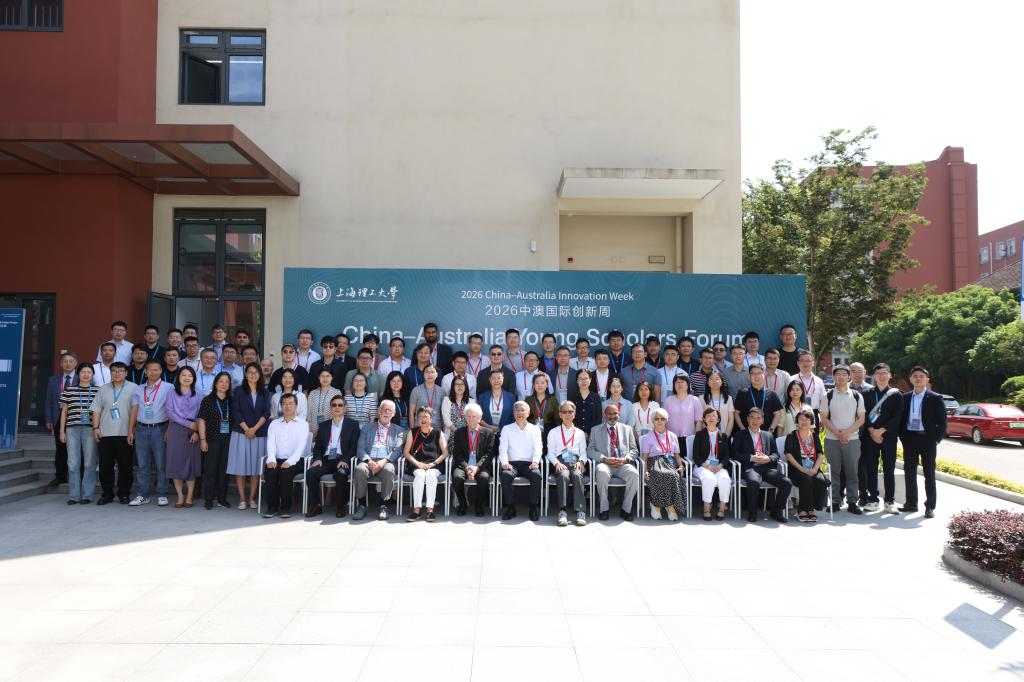
To deepen bilateral exchanges and practical cooperation between China and Australia in the fields of science and technology innovation, higher education, and industry, and to establish a platform for cross-border collaborative innovation among industry, academia, and research institutions as well as for the development of young talent, the China-Australia Young Scholars Forum was held on June 1 at University of Shanghai for Science and Technology(USST) as a key side event of the 2026 China-Australia International Innovation Week. The forum was organized by USST, with strong support from the Federation of Overseas Chinese Scholars in Australia (FOCSA).
The forum invited Professor Dou Shixue, Fellow of the Australian Academy of Engineering; Professor Zhang Xiwang, Fellow of the Australian Academy of Engineering; and Professor Wang Guoxiu, Fellow of both the Australian Academy of Science and the Australian Academy of Engineering, to serve as conference chairs. Professor Wu Chao from USST and Professor Duan Xiaoguang from the University of Adelaide served as executive chairs. The event brought together academicians, renowned experts and scholars, outstanding young researchers, and industry representatives from both China and Australia. Participants engaged in comprehensive and in-depth discussions on core topics including China-Australia industry-academia-research collaborative innovation, the industrialization of scientific and technological achievements, transnational industrial chain cooperation, the establishment of joint research platforms, two-way talent mobility, and the career development of young scholars. These discussions helped build consensus and pool resources for scientific and technological innovation cooperation and the development of young talent between the two countries.
The opening ceremony of the forum was presided over by Professor Liu Baolin, Dean of the School of Energy and Power Engineering. Wang Lingyu, Party Secretary of USST, attended the event and delivered a welcome address. He noted that China and Australia possess strong complementarities and vast potential for cooperation in fields such as new materials, new energy, environmental engineering, and high-end manufacturing. He emphasized that young scholars are the driving force behind scientific and technological innovation and represent the future and hope of research collaboration between the two nations. USST has consistently adhered to the philosophy of internationalization and the integrated development of industry-academia-research. It hopes to use this forum as an opportunity to continuously deepen exchanges and cooperation with leading Australian universities, research institutions, and industrial entities, building a platform for academic exchange, joint talent cultivation, and the sharing of research outcomes. This initiative aims to facilitate the integration of scientific and technological innovation resources between the two countries, support the growth of young talent, and promote high-quality industrial development.
In his opening remarks, Academician Dou Shixian, Chair of the Conference, noted that global scientific and technological innovation has entered a new phase of rapid iteration and cross-disciplinary convergence, with cross-border and cross-disciplinary collaborative innovation becoming the mainstream trend in scientific research. Research teams from China and Australia have long maintained a solid foundation of cooperation, yielding fruitful results in fields such as energy materials, green chemistry, and intelligent engineering. He noted that young scholars, with their active minds and strong drive for innovation, are the core force driving continuous breakthroughs in scientific research between the two countries. He expressed hope that this forum would build a bridge for exchange among young scholars from both nations, fostering more original research outcomes and substantive collaborative projects.
Academician Zhang Xiwang, Chair of the Conference, delivered remarks addressing the current state of China-Australia scientific and technological innovation cooperation. He stated that scientific and technological innovation cannot be separated from openness and cooperation; compared to traditional research models, scientific research in the new era places greater emphasis on cross-disciplinary integration, the practical application of research outcomes, and the joint cultivation of talent. He expressed hope that this forum would break down barriers between university research, industrial applications, and talent development, facilitate the implementation of cooperative mechanisms such as Sino-Australian joint laboratories, joint funds, and two-way talent exchanges, and help young scholars broaden their international horizons, overcome research bottlenecks, and establish a new framework for sustainable, in-depth Sino-Australian science and technology innovation cooperation.
During the keynote session, Professor Hongxia Wang, a Fellow of the Australian Academy of Technology and Engineering and a professor at Queensland University of Technology, delivered a plenary lecture titled “From Laboratory to Mass Production: Sustainable Perovskite Solar Cells for Practical Applications,” focusing on the pain points of perovskite solar cell industrialization. She systematically elaborated on key core technologies such as material optimization, process iteration, and green fabrication, clearly mapping out the full innovation pathway for photovoltaic materials from basic laboratory research to industrial mass production, thereby providing important guidance for the sustainable development of the new energy photovoltaic industry. Professor Zhang Qiang from Tsinghua University, Associate Editor of JACS, delivered a keynote speech titled “Lithium Bond Chemistry Empowering the Development of Energy Storage Materials.” Grounded in cutting-edge lithium bond chemistry theory, he deeply analyzed the enabling role of theoretical innovations in the design, performance optimization, and system transformation of new type of energy storage materials. He showcased several breakthrough research achievements in the field of energy storage materials, offering new insights for the iterative upgrading of high-safety, high-performance energy storage technologies.
The thematic discussion session featured specialized panels focused on two core dimensions—industry-academia-research collaboration and youth development—precisely addressing the needs of Sino-Australian scientific and technological innovation cooperation. The first session, themed “Mutual Benefit and Win-Win: New Pathways for Sino-Australian Industry-Academia-Research Collaborative Innovation,” was chaired by Academician Wang Guoxiu. It featured special guests including Professor Robin Batterham of the University of Melbourne—former President of the Australian Academy of Technology and Engineering, Fellow of the Australian Academy of Science and Engineering, and Foreign Member of the Chinese Academy of Engineering—as well as Professor Vicki Chen, Honorary Professor at the University of Queensland and Fellow of the Australian Academy of Technology and Engineering, Professor Michael Hood (FEAE, Emeritus Professor at the University of Queensland), as well as Professor Yuan Chen from the University of Sydney and Professor Cheng Qunfeng from the University of Science and Technology of China. Taking a holistic view of the development of the research-to-commercialization ecosystem in China and Australia, the panelists focused on key fields such as materials science, energy and chemical engineering, environmental engineering, and biotechnology. They engaged in in-depth discussions on the challenges and bottlenecks in translating research outcomes into practical applications, explored innovative models for collaborative interaction among universities, research institutes, and industry, and offered recommendations for deepening the integration of industry, academia, and research in China and Australia, as well as for the industrialization of technological achievements.
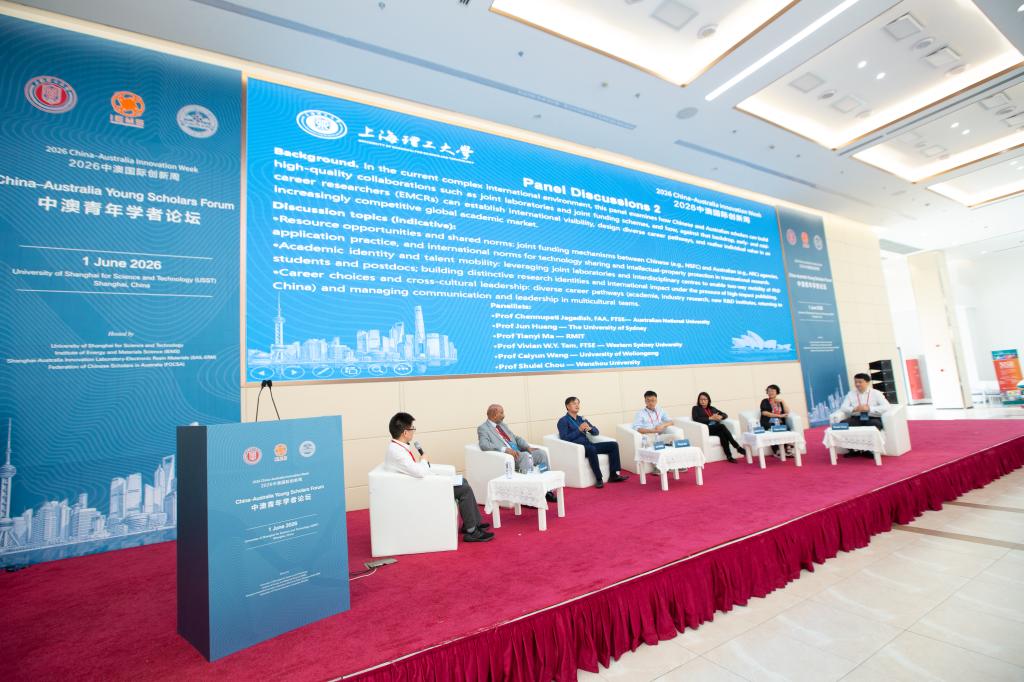
The second workshop, themed “Cross-Boundary Integration: International Research Collaboration and the Career Development of Young Scholars,” was chaired by Professor Zhi Gang Chen from the Queensland University of Technology. Professor Chennupati Jagadish, President of the Australian Academy of Science, Foreign Member of the Chinese Academy of Sciences, and Professor at the Australian National University; Professor Huang Jun from the University of Sydney; Professor Ma Tianyi from RMIT University; Professor Vivian W.Y. Tam, Fellow of the Australian Academy of Engineering and Professor at Western Sydney University; Professor Wang Caiyun from the University of Wollongong; and Professor Shi Shulei from Wenzhou University gathered for the discussion. The participating experts engaged in a discussion on new pathways for collaboration within the complex international research environment. The experts focused on sharing experiences regarding key issues such as the application for Sino-Australian joint projects, transnational intellectual property protection, the two-way flow of master’s, doctoral, and postdoctoral talent, building international academic reputations for young scholars, managing cross-cultural scientific research teams, and diverse career planning. They offered advice to help young researchers from both countries break down development barriers and build international growth platforms.
The forum featured a special session with a top-tier journal editor, featuring a keynote lecture by Dr. Zhang Yaqing, Senior Editor of Nature Sustainability. Drawing on the topic selection criteria, peer review logic, and academic evaluation systems of top-tier international journals, Dr. Zhang Yaqing provided a detailed overview of the journal’s positioning, scope of coverage, review process, and submission guidelines. Focusing on cutting-edge fields such as sustainable materials, green chemistry, and clean energy, she offered an in-depth explanation of methods for identifying, refining, and disseminating high-quality research outcomes, providing professional guidance to faculty and students on enhancing the quality of their research and facilitating the publication of high-impact papers.
To broaden the scope of academic exchange and facilitate in-depth discussions within specific research fields, the forum simultaneously hosted two parallel sessions featuring specialized academic presentations on cutting-edge materials and energy technologies, bringing together young research leaders from China and abroad to share their latest research findings. The first session was moderated by Professor Wang Yunxiao from USST and Professor Yang Fuhua from Central South University during the first half, with Professor Liu Borun from Griffith University serving as moderator for the second half. This session invited 10 experts and scholars from China’s “Double First-Class” universities, universities in Hong Kong and Macao, and top Australian universities to deliver specialized presentations. Research topics spanned new energy storage, electrocatalytic technology, nanosensing materials, and functional materials for extreme environments, balancing theoretical innovation, key technological breakthroughs, and engineering applications. The academic content combined depth with practicality, offering attendees a rich exchange of cutting-edge knowledge.
Session 2 was co-chaired by Professor Dou Yuhai from USST, Dr. Yufei Zhao from the University of New South Wales, Professor Bai Zhongchao from USST, and Dr. Shuying Wu from the University of Sydney. Young academic leaders from leading universities in China and Australia gathered to share their research, covering interdisciplinary frontier areas such as high-safety energy storage batteries, dynamic functional composites, solar-powered hydrogen storage technology, MOF membrane separation technology, flexible smart sensing, smart city pipeline network upgrades, and electrocatalytic metallurgy. Their presentations showcased the innovative vitality and research capabilities of young scholars from both countries in the fields of new materials, new energy, environmental engineering, and smart infrastructure.


 Home
·
News & Events
·
Content
Home
·
News & Events
·
Content