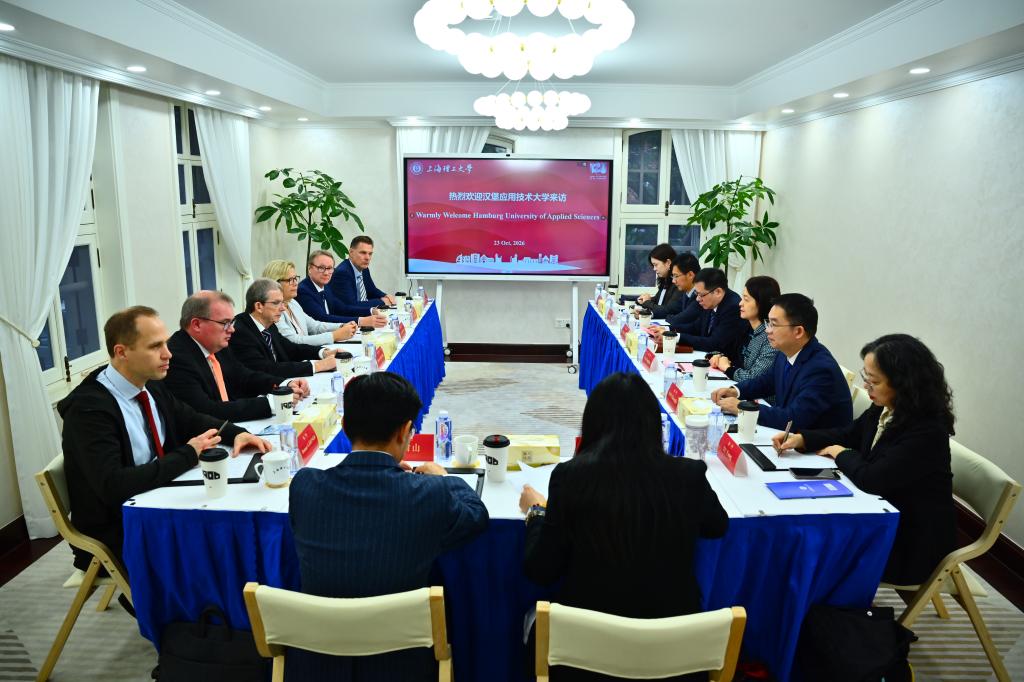
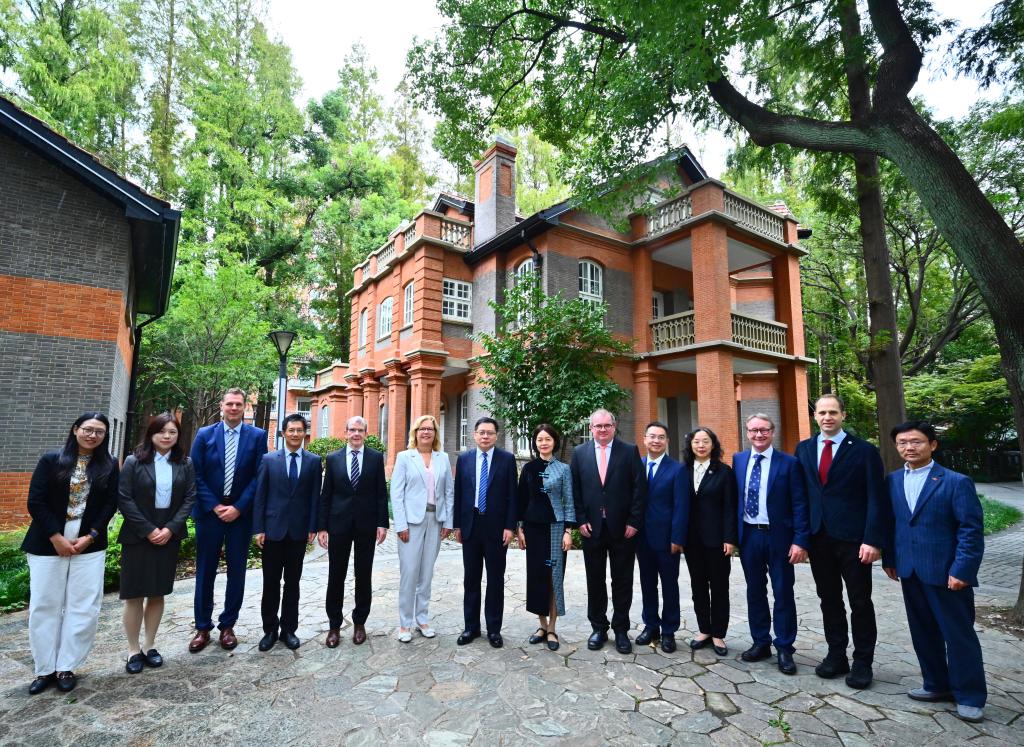
On the morning of October 23, coinciding with the 120th anniversary of University of Shanghai for Science and Technology, a delegation led by Ute Lohrentz, President of Hamburg University of Applied Sciences, visited our university. President Zhao Zhen and Vice President Cai Yonglian met with the guests. The two sides reviewed their more than 40-year history of cooperation and engaged in in-depth discussions on deepening Sino-German educational cooperation and expanding areas of collaboration. Relevant officials from the International Affairs Office and the Sino-German College accompanied the meeting.
On behalf of USST, Zhao Zhen extended a warm welcome to President Lohrentz and her delegation and expressed sincere gratitude to Hamburg University of Applied Sciences for its long-standing partnership, mutual trust, and continuous deepening of cooperation and exchange with our university. He noted that the Sino-German College serves not only as a key platform for our university’s Sino-foreign cooperative education programs but also as a landmark achievement in educational cooperation under the Shanghai–Hamburg sister-city framework. The college’s three undergraduate programs—Electrical Engineering, Mechanical Engineering, and International Economics and Trade—have consistently maintained ASIIN international accreditation; In 2025, the College was recognized as an “Outstanding Sino-Foreign Cooperative Education Institution,” and was the only Sino-German cooperative education institution on the list. This achievement is the result of the joint efforts of both universities. Standing at a new starting point for development, we look forward to both parties continuing to use the Sino-German College as a bridge: on one hand, to consolidate and enhance the quality of existing dual-degree undergraduate programs, strictly adhere to international accreditation standards, and continuously ensure educational quality; on the other hand, building on Hamburg University of Applied Sciences’ distinctive strengths in fields such as renewable energy, aerospace manufacturing, mechanical engineering, and information technology, and combining them with our university’s solid foundation in engineering education, to actively explore new avenues for joint research, industry-academia-research collaboration, and multi-level faculty and student exchanges, thereby continuing to foster exchanges between the sister cities of Shanghai and Hamburg and serving Sino-German educational and cultural exchanges.
Lorenz extended her congratulations to USST on its 120th anniversary and expressed her gratitude for the university’s warm hospitality. She noted that this was her third visit to our university. The two universities’ commitment to regular in-person exchanges demonstrates that their partnership extends beyond a framework agreement and is rooted in dynamic, mutually trusting, and reliable practical cooperation. She reviewed the history of cooperation between the two universities, which dates back to 1985. The establishment of the Shanghai–Hamburg College in 1998 marked a significant milestone in their collaborative history; the three joint undergraduate programs have laid a solid foundation for long-term, stable cooperation. Following the signing of a new round of cooperation agreements in 2024, the number of exchange students from Hamburg University of Applied Sciences coming to China has grown steadily, and the joint undergraduate programs have once again successfully passed unconditional accreditation. Through funding programs supported by the German Academic Exchange Service (DAAD), students from USST regularly travel to Hamburg to participate in summer school programs and corporate internships; a series of achievements fully demonstrates that the partnership between the two universities has entered a phase of high-quality development. She expressed gratitude for the support USST has provided to various cooperative projects, and introduced new trends in the development of German higher education. She emphasized that the partnership between the two universities is an integral part of the friendly city cooperation framework between Shanghai and Hamburg; regardless of changes in the external environment, this solid inter-university partnership holds significant strategic value.
At the meeting, participants engaged in in-depth discussions on how to enhance the quality and sustainable development of Sino-German cooperative education programs under the new circumstances, with the aim of jointly cultivating more outstanding, internationally-oriented applied professionals.


 Home
·
News & Events
·
Content